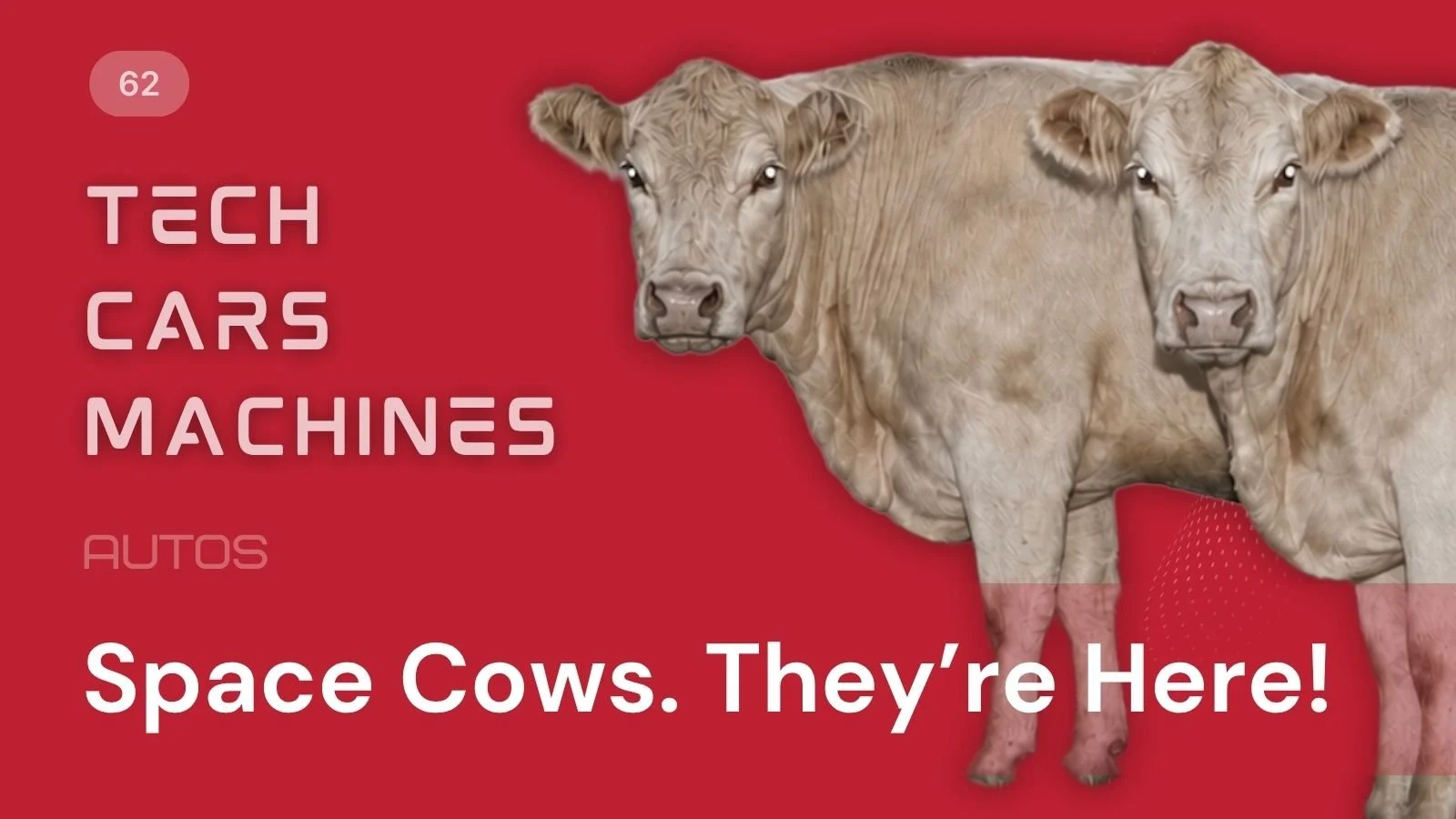
SPACE COWS. THEY’RE HERE!
Listen on your favorite podcast platform:



This episode centers on a 130-mile, two-day test of a 2026 Tesla Model Y with Full Self-Driving Supervised (v14.3.6). I drove 125 miles in supervised self-driving mode across urban, suburban, and highway settings, with zero interventions. The car parked itself in structures, street-side spots, and tight lots, day and night.
“For the price, $40K, it’s a better car off the lot than anything else I can think of.” – Ali Tabibian
As a car, the Model Y is a superior automotive appliance: smooth, quiet, powerful, and loaded with techno-wizardry that rivals or exceeds vehicles at much higher price points. Its user interface and self-driving features make it hard to go back, even to a luxury cabin. Tesla’s FSD now feels as capable as Waymo’s robotaxis, and in some ways more natural—less rules-bound, quicker to react, and better at getting along with other drivers. The system adapts to driver preferences with modes from Sloth to Mad Max; Standard mode behaves like most other drivers, while Chill and Sloth are more cautious.
“Space Cows, they’re here. Are they Level 2 or Level 3 Space Cows? We’ll see, and soon, I think.” – Ali Tabibian
Tesla’s data-driven AI approach—feeding the system enormous amounts of human-driven video and actions—has allowed FSD’s performance to “emerge” somewhat suddenly as highly competent. For other OEMs, third-party providers may be the best path forward. For now, Tesla’s FSD is a remarkable, consumer-grade system that still requires supervision—but it’s close enough to Level 3 that one wonders whether the next leaps will come at an accelerating pace.